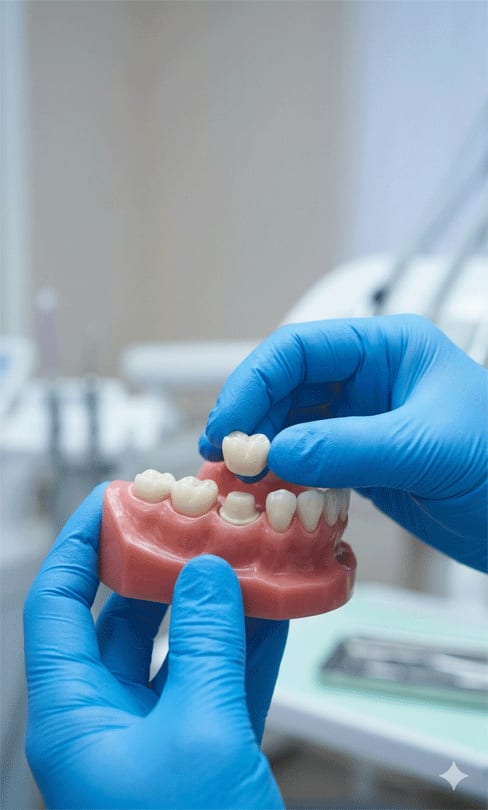
Restorative Dentistry
Crowns
A custom-made cap that covers and protects a damaged or heavily filled tooth.
Learn more about CrownsA fixed way to replace a missing tooth, restoring how you bite, chew and speak as well as how the gap looks.
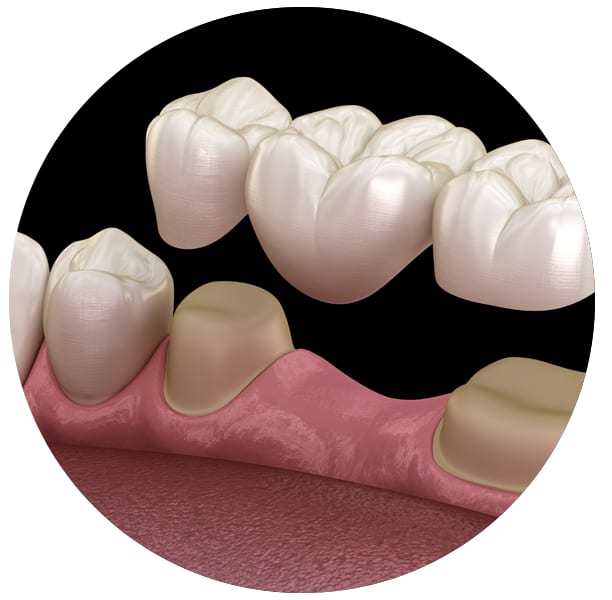
A bridge replaces one or more missing teeth with a false tooth held in place by the teeth on either side of the gap, or in some designs bonded to the back of a neighbouring tooth. Once fitted, it is not removed for cleaning in the way a denture is.
Bridges are made in a dental laboratory to match the shape and shade of your own teeth. Which design suits you depends on the size of the gap, the condition of the teeth around it, and the health of the supporting bone and gums.
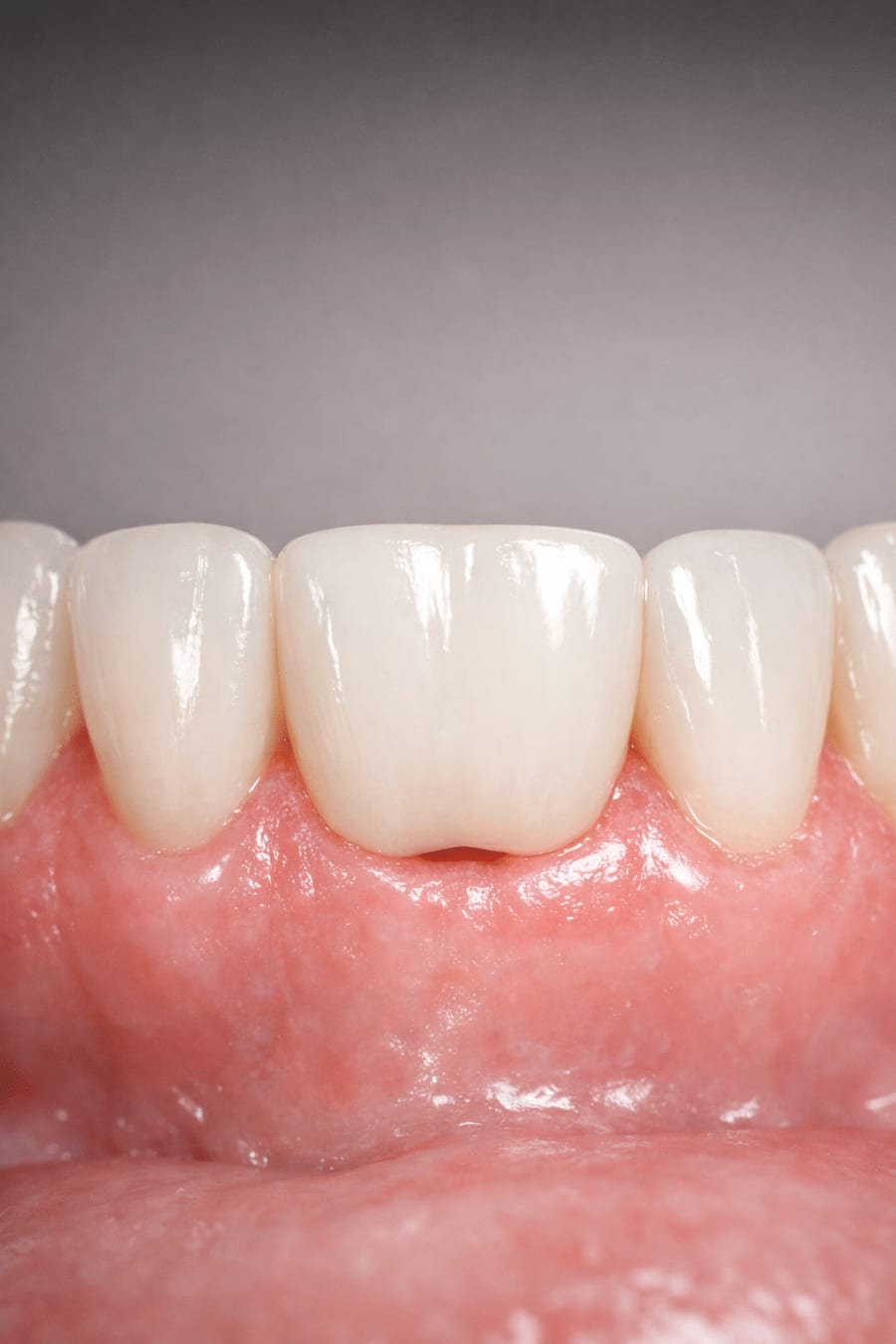
Stays in the mouth rather than being taken out to clean.
Helps with biting and chewing across the gap.
Made to match the shape and shade of your neighbouring teeth.
Conventional, cantilever and Maryland bridges each suit different situations.
The gap, the supporting teeth and the gums are examined, usually with x-rays.
The design and materials are chosen and the fee confirmed in writing.
Supporting teeth are prepared where the design requires it, and impressions taken.
A temporary bridge is fitted while the laboratory makes the final one.
The bridge is fitted, the bite checked, and you are shown how to clean around it.
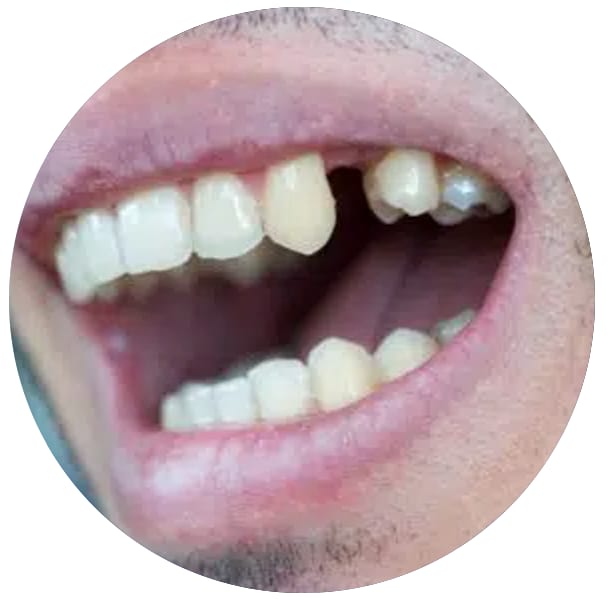
A bridge may suit you if you have a gap with healthy teeth either side. Your dentist will assess those supporting teeth carefully, because they carry the load. Where they are heavily filled or the gap is large, another option may be more appropriate — and that is a conversation to have at consultation.
Usually more than one, with laboratory time in between. Your dentist will set out the schedule.
You will be shown how to clean underneath the bridge — this matters for how long it lasts.
Several options, including metal-free. Fees vary by material; see the price list.
The supporting teeth carry extra load. Keeping them and the gums healthy is essential.
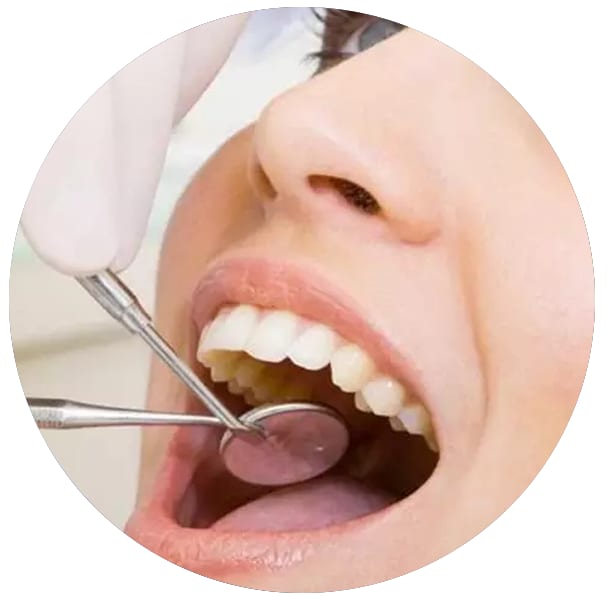
Photography from the practice’s own image library.
If your question is not here, please ask when you contact the practice.
A bridge uses the neighbouring teeth for support; an implant is placed into the jawbone and does not rely on them. Your dentist will explain which options are realistic in your situation.
With special floss or small interdental brushes. We will show you the technique at the fitting appointment and check it at hygiene visits.
This depends on the design, your bite and how well the supporting teeth and gums are cared for. Your dentist will give you a realistic expectation for your case.
Bridges are made in a laboratory to match the shape and shade of your own teeth. Shade is chosen with you before it is made.
Fees depend on the design and materials. Several are listed on our price list, and some are quoted after assessment because laboratory costs vary.
A custom-made cap that covers and protects a damaged or heavily filled tooth.
Learn more about Crowns
The options for replacing missing teeth, compared honestly at consultation.
Learn more about Missing Teeth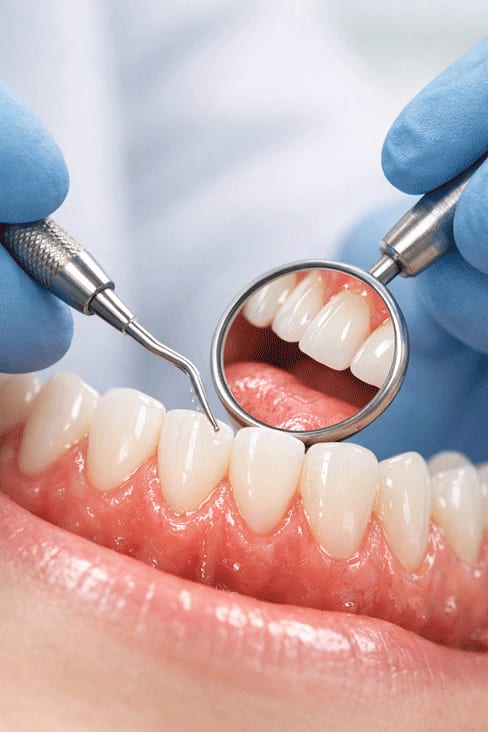
Examinations, fillings and the routine care that keeps problems small.
Learn more about General DentistryTell us a little about what you need and we will call you back to arrange a time.
Liphook sits just off the A3, which bypasses the village — so the practice is straightforward to reach from both Guildford and Petersfield. Leave the A3 at the Liphook turning and follow signs into the village centre; Haslemere Road runs from The Square towards Haslemere.
To confirm: the exact approach you would like described from the north and from the south, and any local landmark to turn at.
For turn-by-turn directions from wherever you are, use the button below — it always reflects live traffic.
Liphook station is on Station Road, Liphook, GU30 7DR, on the Portsmouth Direct Line and managed by South Western Railway.
To confirm: the walking time from the station to 6 Haslemere Road.
Liphook is served by Stagecoach South. The Square, in the village centre, is the main stop and the closest to Haslemere Road.
Timetables change — please check with Stagecoach before travelling, and confirm the walking time from The Square.
Parking behind the practice is free. The car park is directly behind us on Haslemere Road — coming from the village, it is just before you reach Sainsbury's.
There is no charge and no ticket machine, so you can come straight in.
If you are arriving by train instead, the station car park on Station Road has 74 pay-and-display spaces, currently around £5.10 for the day.
To confirm: whether any of the bays behind the practice are marked as blue badge spaces, so we can say so here.
We are at 6 Haslemere Road, a short distance from The Square — the centre of Liphook and the main bus stop. Liphook railway station is on Station Road, and Sainsbury's is a useful landmark on the village's northern side.
To confirm: walking times from The Square and the station, the nearest recognisable landmark to the door, and step-free access details.
The map below shows exactly where we are.
Liphook Smile Studio
6 Haslemere Rd, Liphook, GU30 7AL
Monday to Friday
9:00am – 5:00pm
Closed Saturday & Sunday
Book a consultation and we will assess your teeth and set out your options honestly.